Kelly-Kritär a Roulette
De Kelly-Kritär seet engem Spiller mat engem Virdeel, wéi vill hie setze soll. Fir d'Roulette gëtt en eng kloer Äntwert: näischt.

Kelly-Mise = Virdeel / Quot. Mat engem negative Virdeel gëtt d'Formel en negativen Undeel eraus, an dat heescht: net wetten. De Kritär ass trotzdeem nëtzlech, fir ze verstoen, firwat Spiller, déi op Ofwäichunge vum Rad gesat hunn, hir Misen esou dimensionéiert hunn, wéi se et gemaach hunn, a firwat all déi aner hir Mise nom Budget riichte sollten.
De Kritär
John Kelly (1956) asked how a gambler with a known edge should size bets to maximize long-run growth of the bankrollGeldSpillkeessDe ganze Betrag, deen ee fir d'Spill op d'Säit leet. Gestioun vun der Spillkeess heescht z'entscheeden, wéi vill dovun ee pro Wett a pro Sessioun riskéiert.Alles liesen →. The answer, for a bet paying b to 1 with win probabilityMathematikWarscheinlechkeetD'Chance vun engem Resultat, vun 0 bis 1 oder vun 0% bis 100%. Eng Zuel: 1/37 = 2,70%.Alles liesen → p and loss probability q = 1 − p, is to stake the fraction f* = (bp − q) / b of the bankroll. Positive f* means bet that fraction; zero or negative means do not bet. Kelly worked at Bell Labs, and his paper, “A new interpretation of information rate”, set the problem in Claude Shannon’s theory of information: a gambler who gets tips over a noisy line, at fair odds, can grow the bankroll at best at the rate the line carries information. This is a growth objective under a probability model, not a promise to finish ahead after a particular number of bets. A spending limit, finite deadline or payoutGeldAuszuelungWat eng gewonne Wett bréngt, uginn als „X zu 1“ zousätzlech zur zréckbezuelter Mise.Alles liesen → cap changes the decision problem.
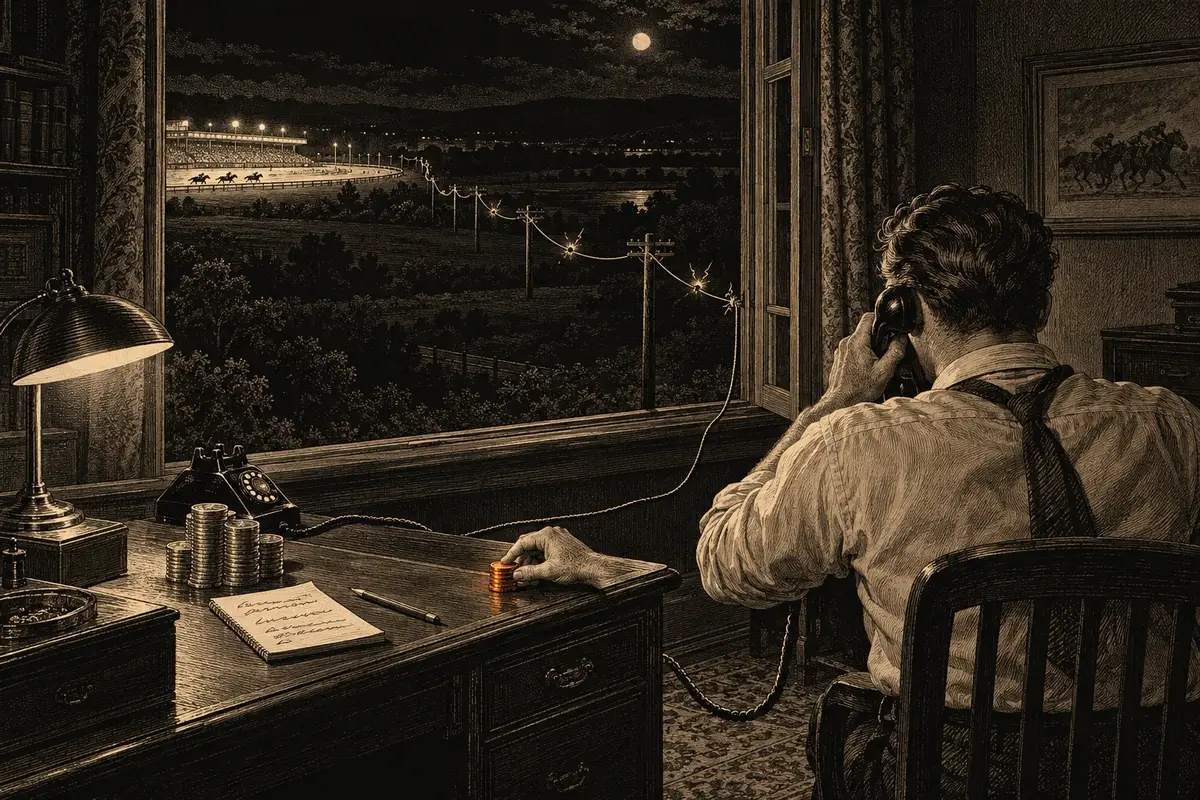
Kelly-Wetten an der Roulette
For redWettRoutEinfach Chance op déi 18 rout Zuelen. Franséisch: rouge.Alles liesen →: b = 1, p = 18/37, q = 19/37; f* = (18/37 − 19/37)/1 = −1/37. For a straight upWettEenzelwettEng eenzel Zuel, bezillt 35:1.Alles liesen →: b = 35, p = 1/37, q = 36/37; f* = (35/37 − 36/37)/35 = −1/1295. Every standard bet gives a negative Kelly fraction, because every bet has a negative edge, and the growth-optimal stake is zero. Kelly betting on roulette is a formal way of saying what the house-edge page says: no positive stake maximizes expected logarithmic growth when the bet has negative expectation. A particular session can still end in profit. La partageReegelLa partageFranséisch Reegel: wann d'Null erauskënnt, gëtt d'Hallschent vun der Mise op enger einfacher Chance zréckbezuelt. Dat halbéiert den Hausvirdeel op dëse Wetten op 1,35%.Alles liesen → needs a separate three-outcome calculation: a win, a full loss or a half-loss on zeroRadNullDat eenzegt gréngt Fach, dat keng einfach Chance, Dosen oder Kolonn ofdeckt; d'Quell vum Hausvirdeel. Och: eenzeg Null, 0.Alles liesen →. Its expected log growth also falls as the stake increases from zero.
Wou de Kelly-Kritär wierklech gegollt huet
Suppose a pocketMaterialFachEent vun de 37 nummeréierte Fächer um Rotor. Op Englesch och: slot, cup.Alles liesen → really has a stable, known probability of 1 in 30 and pays 35 to 1. The Kelly fraction is 0.57%: about $57 from a $10,000 bankroll. Under independent spinsMathematikOnofhängeg CoupenAll Coup huet déiselwecht Warscheinlechkeeten, egal wat virdrun war. D'Basis vun all Berechnung op dëser Websäit.Alles liesen → and exact fractional staking, the geometric growth factor over 1,000 spins is about 1.7. Expected bankroll grows faster because rare large wins pull up the average. These are model calculations, not evidence that any named historical player used Kelly or achieved this result.
Typesch an duerchschnëttlech
The gap between the typical bankroll and the average one is wide. Take a pocket that hits 1 time in 25, a hypothetical edge of 44% per unitGeldEenheetD'Basismise, mat där e System oder e Spiller rechent. Progressioune ginn an Eenheete beschriwwen, sou datt se un all Dësch gëllen.Alles liesen → staked. Kelly stakes 1.26% of the bankroll on it. After 1,000 spins the typical bankroll has grown about 11.5 times, while the average, pulled up by a few very lucky runs, has grown about 249 times. Betting more than Kelly raises the average and lowers the typical result: at twice the Kelly stake the typical bankroll only doubles, and by two and a half times the Kelly stake it shrinks, although every bet still carries a 44% edge. In this example, half-Kelly retains about 78% of the expected log growth. This fraction depends on the probabilities and payout.
Wann de Virdeel just eng Schätzung ass
Kelly uses the true probabilities, but a player usually has only estimates. Selecting the busiest pocket from a past record creates a selection problem: even a fair wheel has a busiest pocket. Its observed rate can overstate its future probability. Choosing the stake from that same record compounds the error. An independent follow-up sample helps test a proposed bias (see How to Detect Roulette Wheel Bias). Reducing the calculated fraction reduces exposure, but cannot turn a false edge into a real one.
Leit mat engem Virdeel
Haghani and Dewey (2016) studied 61 participants given $25 and 30 minutes to bet on a simulated coin with a disclosed 60% chance of heads. The payout cap was $250; its value was revealed when a proposed winning bet would reach it. Their reported 21% success category included balances of at least $200, while the 28% “bust” category meant less than $2, not necessarily zero. Eighteen participants bet their entire balance on one flip. The uncapped Kelly fraction is 20%, but the cap and deadline change the optimization problem. The experiment illustrates how stake choices matter even with a known advantage; it does not establish one best strategy for every objective.
Wat Dir amplaz notze sollt
Ouni Virdeel ass d'Gréisst vun der Mise eng Budgetsfro, keng Wuesstemsfro: Mise = dat, wat Dir pro Coup bereet sidd auszeginn, ofgeleet aus dem Stonnebudget an dem Tempo vum Dësch (Säit Gestioun vun der Spillkeess bei der Roulette). Dem Kelly säi Bäitrag fir den normale Spiller ass d'Kloerheet vu senger Äntwert: null. Alles, wat Dir iwwer null setzt, ass de Präis fir d'Spillen, vun Iech selwer gewielt, net vun enger Formel optiméiert.
Eng Bemierkung zum Bruchdeel-Kelly an zum „Money-Management“
Betting a fixed percentage of the current bankroll is proportional staking: the stake rises after wins and falls after losses. Flat bettingStrategieKonstant MiseAll Coup dee selwechte Betrag setzen. D'Referenz, mat där all Progressioun verglach gëtt.Alles liesen → instead keeps the cash stake fixed. Neither creates an edge on ordinary roulette. With infinitely divisible stakes and a fraction below 100%, proportional staking never reaches exactly zero in finitely many losses, but the balance can become arbitrarily small. Real table minimums can prevent further play much sooner. The growth-optimal fraction remains zero.
Formel
Froen
Only when the actual probabilities, payouts and conditions give a credible positive advantage. Standard bets on an unbiased wheel have no such advantage.
Using half the calculated fraction reduces exposure to errors in the estimated edge. The familiar three-quarters-growth rule is an approximation for small advantages, not a universal identity. It does not protect against an edge that does not exist.
Nee. De Kelly optiméiert de Wuesstem, wann et e Virdeel gëtt. D'Gestioun vun der Spillkeess kontrolléiert d'Ausgaben, wann et kee gëtt.
Spaass mat Mathematik
Probéiert et fir d'éischt selwer. All Léisung ass zougeklappt; maacht se op, wann Dir prett sidd.
Suppose a hypothetical bet on one number has a known 44% edge under standard payoutsGeldAuszuelungWat eng gewonne Wett bréngt, uginn als „X zu 1“ zousätzlech zur zréckbezuelter Mise.Alles liesen → and independent spinsMathematikOnofhängeg CoupenAll Coup huet déiselwecht Warscheinlechkeeten, egal wat virdrun war. D'Basis vun all Berechnung op dëser Websäit.Alles liesen →. Kelly gives a 1.26% bankrollGeldSpillkeessDe ganze Betrag, deen ee fir d'Spill op d'Säit leet. Gestioun vun der Spillkeess heescht z'entscheeden, wéi vill dovun ee pro Wett a pro Sessioun riskéiert.Alles liesen → fraction. What if the same 44% edge came on one bet spread over five neighboring numbers?
D'Léisung weisen
Äntwert Da seet de Kelly-Kritär 7,1% vun der Spillkeess, an d'Spillkeess wiisst bal sechs Kéier esou séier: iwwer 1.000 Wetten ëm de Faktor 1,25 Milliounen, géint e Faktor vun ongeféier 11,5.
A straight upWettEenzelwettEng eenzel Zuel, bezillt 35:1.Alles liesen → with a 44% edge wins with chance 0.04, since 36 × 0.04 = 1.44. Kelly’s stake is the edge divided by the odds: 0.44/35 = 1.26%. The typical growth per bet is 0.04 × ln(1 + 35 × 0.0126) + 0.96 × ln(1 − 0.0126) ≈ 0.00244, so 1,000 bets multiply the bankroll by about e^2.44 ≈ 11.5.
Spread one stake over five numbers and the bet wins with chance 0.20 and pays 36/5 for 1, that is 6.2 to 1: still a 44% edge, since 0.2 × 7.2 = 1.44. Kelly’s stake becomes 0.44/6.2 = 7.10%, and the growth per bet 0.01404, about 5.75 times as much. Over 1,000 bets that is e^14.04, about 1.25 million.
The edge is the same; the swings are smaller. A bet that wins one time in five has a larger growth-optimal fraction in this model, although losses can still reduce the bankroll severely. This comparison assumes the same known edge for both bets; actual predictions need independent evidence.
Assume two numbers are adjacent on the betting layoutMaterialTableauDat gedréckt Wettfeld um Dësch. Och: Spillfeld, Spillduch.Alles liesen → and each has a stable, known probabilityMathematikWarscheinlechkeetD'Chance vun engem Resultat, vun 0 bis 1 oder vun 0% bis 100%. Eng Zuel: 1/37 = 2,70%.Alles liesen → of 1 in 25 on independent spins. Compare a splitWettZwéierwettZwou niewenee leiend Zuelen, bezillt 17:1.Alles liesen → between them at 17 to 1 with equal straight-up stakes on the two numbers. How much does Kelly say, and how fast does the bankroll grow compared with one such pocketMaterialFachEent vun de 37 nummeréierte Fächer um Rotor. Op Englesch och: slot, cup.Alles liesen →?
D'Léisung weisen
Äntwert Et mécht keen Ënnerscheed: 2,59% vun der Spillkeess op der Zwéierwett oder 1,29% op all Zuel. Déi typesch Spillkeess wiisst an 1.000 Coupen ongeféier ëm de Faktor 155, géint 11,5 mat engem Fach.
The split wins with probability 2/25 = 0.08 and pays 17 to 1, so it returns 18 × 0.08 = 1.44 per unitGeldEenheetD'Basismise, mat där e System oder e Spiller rechent. Progressioune ginn an Eenheete beschriwwen, sou datt se un all Dësch gëllen.Alles liesen → staked: an edge of 44%, the same as one biased pocket. Kelly’s stake is the edge divided by the odds: 0.44/17 = 2.59%.
Two straight-up bets of 1.29% each give exactly the same results. When either number comes up, one chipGeldJetonE Spillstéck, dat e feste Betrag duerstellt an op den Tableau geluecht gëtt, fir eng Wett ze maachen. Op Englesch och: check.Alles liesen → wins 35 to 1 and the other is lost, a net of 34 × 1.29% = 44% of the bankroll, as the split pays; when neither does, both are lost.
The growth per spin is 0.00505, against 0.00244 for one pocket, so over 1,000 spins the typical bankroll grows e^5.046 ≈ 155 times rather than e^2.44 ≈ 11.5 times. The geometric growth factor is larger because the combined bet wins more often at the same 44% edge. It is a model result, not a guaranteed bankroll.
E bësse Humor
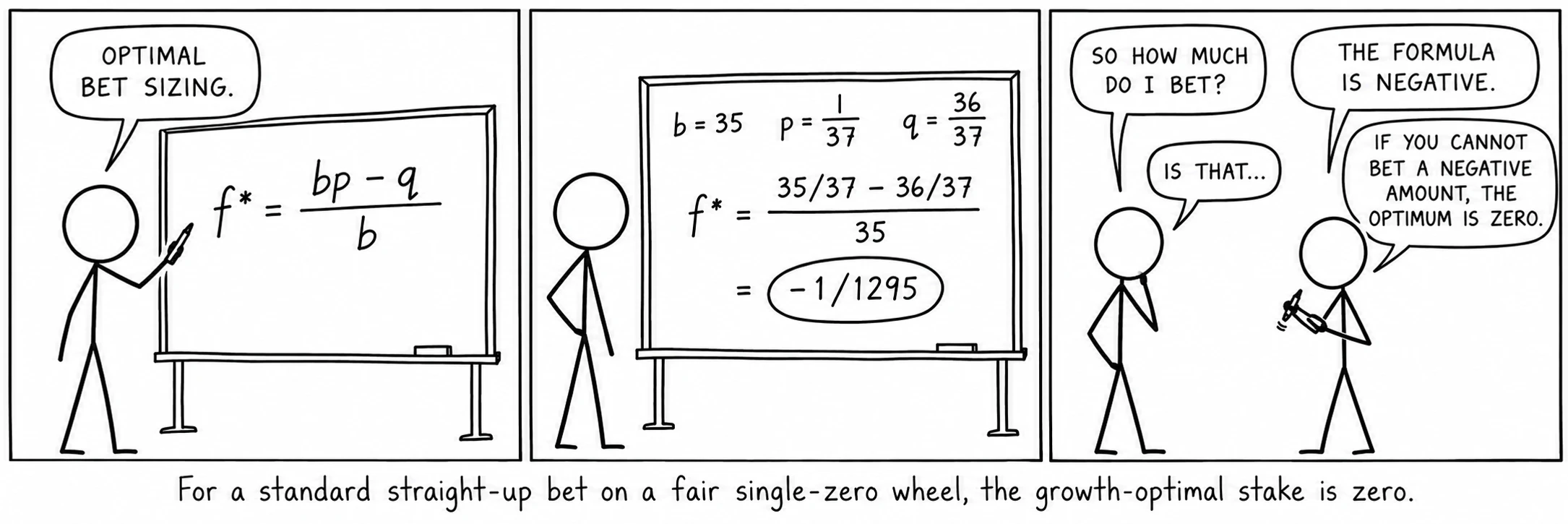
Déi optimal Roulettemise fir de Wuesstem ass eng Zuel, déi jidderee scho kennt.
Quellen
- Kelly, J. L. „A new interpretation of information rate.“
- Breiman, L. „Optimal gambling systems for favorable games.“
- Thorp, E. O. „Optimal gambling systems for favorable games.“
- Thorp, E. O. The Mathematics of Gambling.
- Epstein, R. A. The Theory of Gambling and Statistical Logic, 2. Oplo.
- Taylor, D. G. Games, Gambling, and Probability: An Introduction to Mathematics, 2. Oplo.
- Ethier, S. N. The Doctrine of Chances: Probabilistic Aspects of Gambling.
- Haghani, V. & Dewey, R. „Rational decision-making under uncertainty: observed betting patterns on a biased coin.“